Galaxy formation and evolution is an inherently multiscale complex process, which remains one of the central problems of modern astrophysics. I am a computational astrophysicist and together with my collaborators I design, run, and analyze numerical simulations of galaxies to gain insights that advance our understanding of how galaxies form and evolve. Below is a brief summary of my recent work.
Modeling Early Turbulent Formation and Evolution of Galaxies

JWST has revealed a surprisingly large population of UV-bright galaxies in the early Universe. Many of the early galaxies exhibit disk morphologies, which also corroborates earlier discoveries of very early (z>4) dynamically cold gas disks discovered by ALMA. The high abundance of early bright galaxies can be explained by early vigorous variations in galactic star formation, which, however, can also be a reason for the delayed formation of galactic disks in high-resolution cosmological simulations. We show that the detailed modeling of star formation coupled with the turbulent state of the interstellar medium (ISM) is critically important for producing both early variable star formation rates and the formation and survival of early disk galaxies, as it captures the qualitative change in the ISM turbulence driving and resulting star formation mode before and after disk formation.
For more details see our papers:
• How Early Could the Milky Way’s Disk Form?
• From UV-bright Galaxies to Early Disks: the Importance of Turbulent Star Formation in the Early Universe
How Unusual is the Milky Way’s Disk?

Recent spectroscopic and astrometric surveys of Milky Way (MW) stars (such as Gaia, H3, APOGEE) have revealed that the disk of our Galaxy could form surprisingly early, within the first 2 billion years of evolution. This is significantly earlier than what was found in high-resolution cosmological simulations zooming in on individual MW-like galaxies. In this series of papers, my collaborators and I investigated the formation of MW-like galaxies in a large-volume cosmological simulation (Illustris TNG50). We find that, indeed, MW-mass galaxies on average form later than the MW, however, the variation in the formation time is large, so that about 10% of such galaxies form disks as early as the MW. These results suggest that the MW is unusual but also not very uncommon.
For more details and the exploration of the physics of disk formation, see our papers:
• Formation of Galactic Disks. I. Why Did the Milky Way’s Disk Form Unusually Early?
• Formation of Galactic Disks. II. The Physical Drivers of Disk Spin-up
• The Three-phase Evolution of the Milky Way
and this Forbes article.
Why do galaxies form stars inefficiently?

In this series of papers, my collaborators and I outline a framework that connects galaxy-scale star formation rates to the timescales of gas cycling on the scales of star-forming regions. This framework can be used to explain many puzzling phenomena including the global inefficiency of star formation, a near-linear correlation between star formation and molecular gas on kiloparsec scales, and self-regulation of star formation in galaxy simulations.
― Read more
For more detail see our papers:
• The Physical Origin of Long Gas Depletion Times in Galaxies
• How Galaxies Form Stars: The Connection between Local and Global Star Formation in Galaxy Simulations
• What Sets the Slope of the Molecular Kennicutt-Schmidt Relation?
ISM structure as a probe of the star formation-feedback loop
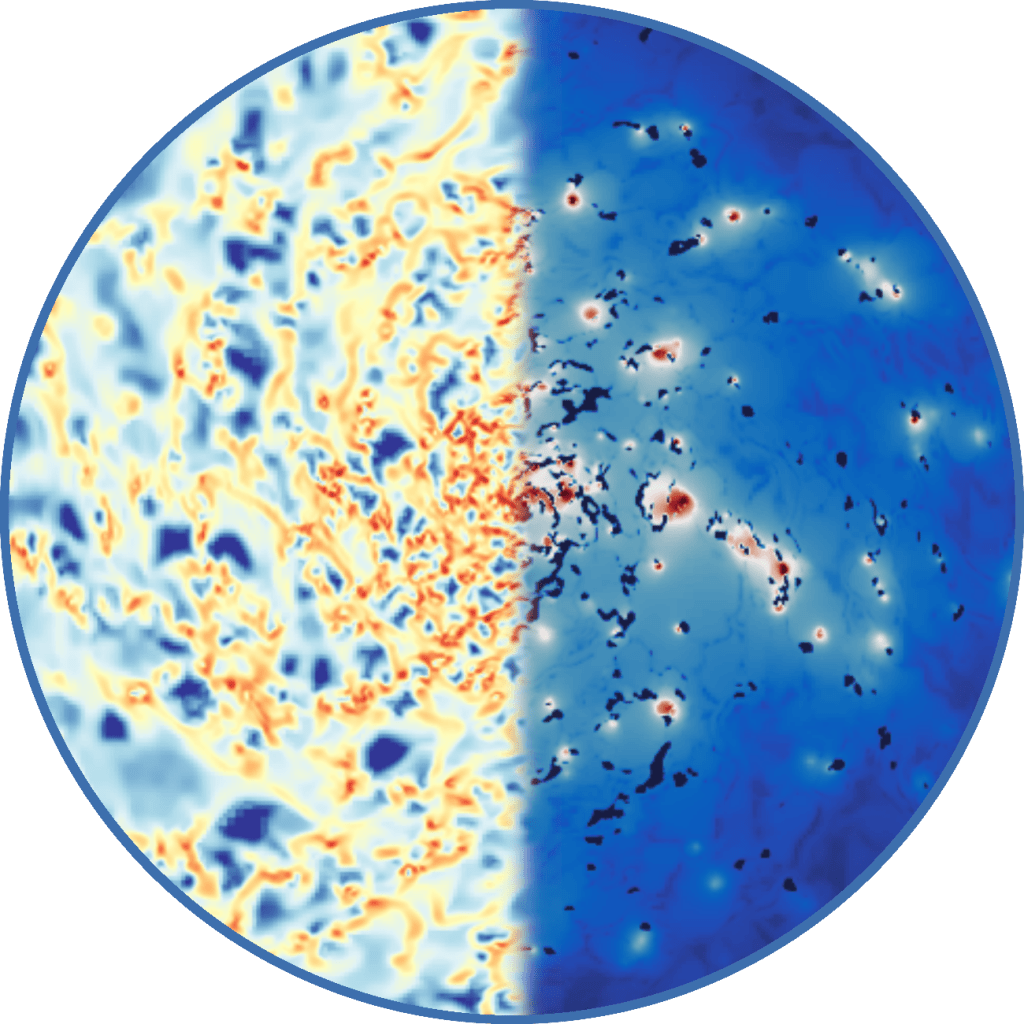
The structure of the interstellar medium (ISM) is largely shaped by star formation and stellar feedback and therefore its statistical properties imprint invaluable information about these processes. In this work, we explore how the spatial decorrelation of dense gas and young stars on a range of scales depends on the details of star formation and feedback modeling in galaxy simulation.
― Related visualizations
For more detail see our paper:
Spatial Decorrelation of Young Stars and Dense Gas as a Probe of the Star Formation-Feedback Cycle in Galaxies
Cosmic ray feedback

Cosmic rays — relativistic particles accelerated in regions of active star formation — constitute a significant fraction of pressure and energy budget in the interstellar medium and therefore they can strongly affect galaxy evolution. The key uncertainty is the way how cosmic rays propagate through galaxies and interact with the (thermal) gas. Recent observations suggest that cosmic ray propagation is significantly slower near star-forming regions than in the average interstellar medium. In this paper, we show that such a reduced propagation qualitatively changes the structure of galaxies suppressing formation of dense gas clumps, particularly in gas-rich unstable galaxies.
― Related visualizations
For more detail see our paper:
Cosmic-Ray Diffusion Suppression in Star-forming Regions Inhibits Clump Formation in Gas-rich Galaxies
Modeling unresolved turbulence and star formation in galaxy simulations

The efficiency at which dense gaseous regions of galactic gas form stars is expected to strongly depend on the small-scale turbulence. In galaxy simulations, turbulent motions on such small scales cannot be resolved. In this paper, we explore how the modeling of star formation can be improved by explicitly modeling unresolved turbulence using the so-called Large Eddy Simulation methodology which is actively used to model turbulent flows in aerospace engineering and geophysical simulations.
― Read more
For more detail see our paper:
Nonuniversal Star Formation Efficiency in Turbulent ISM
Nonthermal entropy conservation in fluid dynamics simulations

Nonthermal pressure components, such as turbulence and cosmic rays, are some of the key mediators of star formation feedback (see above). In this paper, we explore different numerical schemes for modeling such components in fluid dynamics simulations. We show that the scheme that enforces entropy conservation is a preferred choice. We also propose a simple method for injection of nonthermal energy by shocks and generation of unresolved turbulence which can be used in conjunction with an entropy-conserving scheme.
For more detail see our paper:
Entropy-Conserving Scheme for Modeling Nonthermal Energies in Fluid Dynamics Simulations
 Vadim Semenov